Summary: In the first smell processing center of insects (AL) and mammals (OB), the main modulatory hormone that mediates hunger-dependent changes in neuronal function is insulin. How does insulin mediate the hunger-dependent changes in olfactory neuron function to affect the animal’s behavior? This main question leads to two sub-questions that underlie projects in the Mathew lab: I) How does insulin mediate the hunger-dependent changes in olfactory sensory neurons (OSNs) to affect the animal’s sensitivity to odors? and II) How does insulin mediate the hunger-dependent changes in a key local neuron to affect the animal’s olfactory decision-making?
To address these questions, we take advantage of the Drosophila larva, which allows incisive genetic and molecular analyses of olfactory neurons and their functions.
Project I. How does insulin mediate the hunger-dependent changes in OSNs to affect the larva’s sensitivity to odors?
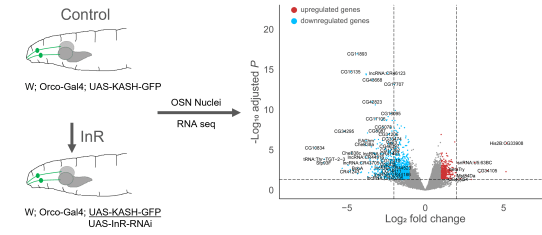 Using the Drosophila melanogaster larva, we showed that insulin and leptin pathways interact within OSNs to affect their function. We also showed that manipulating these signaling pathways specifically in the OSNs impact the larva’s behavior toward odors, its feeding behavior, and its body weight. With the help of the genetic, molecular, and imaging tools we have developed in the lab, we have a unique opportunity to determine the molecular mechanisms downstream of insulin signaling in OSNs and investigate their relationship to animal physiology.
Publication: Slankster E, Kollala S, Baria D, Dailey-Krempel B, Jain R, Odell SR and Mathew D. Mechanism underlying Starvation-dependent modulation of olfactory behavior in Drosophila (2020) Scientific Reports 10(1):3119. [Link]
Project II. How does insulin mediate the hunger-dependent changes in Keystone-LN to affect the larva’s decision-making?
 Using the Drosophila melanogaster larva, we demonstrated a critical role for Keystone-LN, an antennal lobe local neuron, during larval head-sweep behavior. Head sweeps are an important adaptive behavior in crawling insects. We showed that insulin signaling in this key local neuron likely mediates satiety-dependent flexibility in head-sweep behavior, shaping the larva’s navigation. We will build on this research so far to ask another set of interesting questions: 1) how is the insulin signaling mechanism in an inhibitory local neuron distinct from other neurons? 2) why is it essential to modulate an inhibitory component of a circuit to adjust behavioral decisions based on satiety states?
Publication Clark D, Zito N, Jain R, Gong H, Warnock K, Carrion-Lopez R, Maixner C, Prieto-Godino L, Mathew D. “Internal state affects local neuron function in an early processing center to shape olfactory behavior in Drosophila larvae,” (2022) Scientific Reports 12 (1): 15767. [Link]
Grant Support: This Project is supported by an NSF-IOS award (Award No. 2341202) to the Mathew Lab.

 Mathew Lab